Insights
•
The Death of Traditional Keywords: How AI Search Changed SEO Forever
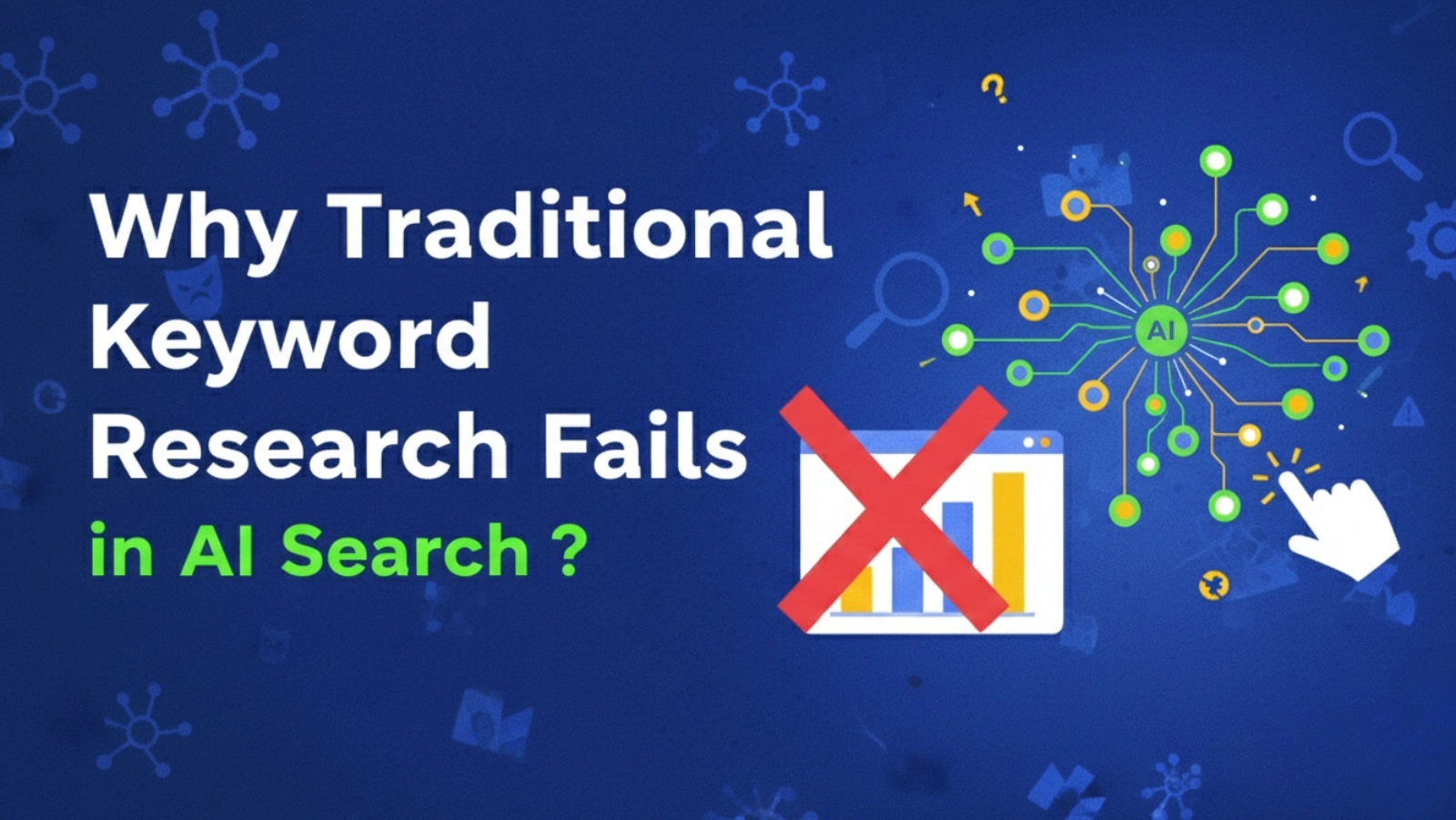
For the last two decades, search engine optimization was simple: find a high-volume keyword, sprinkle it across your blog post 5 to 6 times, build a few links, and wait for Google to rank your page.
But if you are still running your business using this old playbook, your traffic is about to drop to zero.
Welcome to the era of AI Search. With Google’s AI Overviews, ChatGPT Search, and Perplexity rapidly taking over, the way people find information has fundamentally changed. Traditional keywords are practically dead.
Here is exactly what is happening to search traffic right now and how your brand can survive this massive shift.
1. From "Keywords" to "Conversations"
Think about how you use the internet today. A few years ago, if you wanted to boost your website speed, you would type: "best website speed optimizer." Today, you type or speak a full conversation: "My custom PHP website using Bootstrap is loading slow on mobile phones, what are the top 3 ways to fix it without breaking my current custom CSS layout?"
AI search engines understand the complete intent, context, and nuances behind these long, complex queries. They don't just scan for exact keyword matches; they scan for deep, structural answers.
2. The Rise of Zero-Click Searches
The biggest threat to modern websites is the "Zero-Click Search." When Google’s AI Overview or ChatGPT answers a user's question directly on the search page, the user has no reason to click through to your website.
Only two types of websites survive this filter:
Websites that provide deep, original, and analytical insights that an AI cannot summarize in two lines.
Websites that are explicitly cited and linked by the AI as the primary trusted source.
3. How to Make Your Content "AI-Proof" (The Actionable Strategy)
To ensure your brand gets picked up and recommended by AI models, you must optimize for AI Search Intent (GEO - Generative Engine Optimization). Here is how you do it:
Answer the Unanswered: Don't write basic definition blogs like "What is SEO?". AI already knows that. Write about specific problem-solving scenarios, bugs, failures, and real-world experiments.
Format for LLMs (Large Language Models): Use clear heading structures (H2, H3), bullet points, and short, punchy paragraphs. AI crawlers love structured data because it is incredibly easy for them to extract and summarize.
Include Direct Quotes and Brand Authority: Mention your unique perspective or client case studies clearly. When your brand name is tied directly to a specific solution, AI engines begin to recognize your website as an industry authority.
Nail the Technical Foundation: An AI search bot will not recommend a website that is slow, broken, or has bad metadata. Secure coding, lightning-fast response times, and clean page layouts are non-negotiable.
Conclusion: Adapt or Disappear
The shift from traditional keywords to AI-driven conversations isn't a trend; it is the permanent future of the internet. The businesses that continue to target empty keyword metrics will vanish from search logs.
However, if you shift your focus toward answering deep human questions with absolute technical precision, AI search engines will not replace you—they will become your primary source of free, high-converting traffic!
Meta Description Suggestion:
Traditional SEO is dead. Discover how Google AI Overviews and ChatGPT Search are destroying keyword traffic, and the exact strategy to make your website AI-proof.
Want to scale your business organic traffic?
Let WebBrandBuilders optimize your search appearance & design strategies.